
Regenerative Medicine & Rejuvenation
Exosomes vs PRP: Which Regenerative Treatment to Choose
Exosomes vs PRP: compare how they work, skin results, number of sessions, and who each regenerative treatment is for. Discover which one to choose.
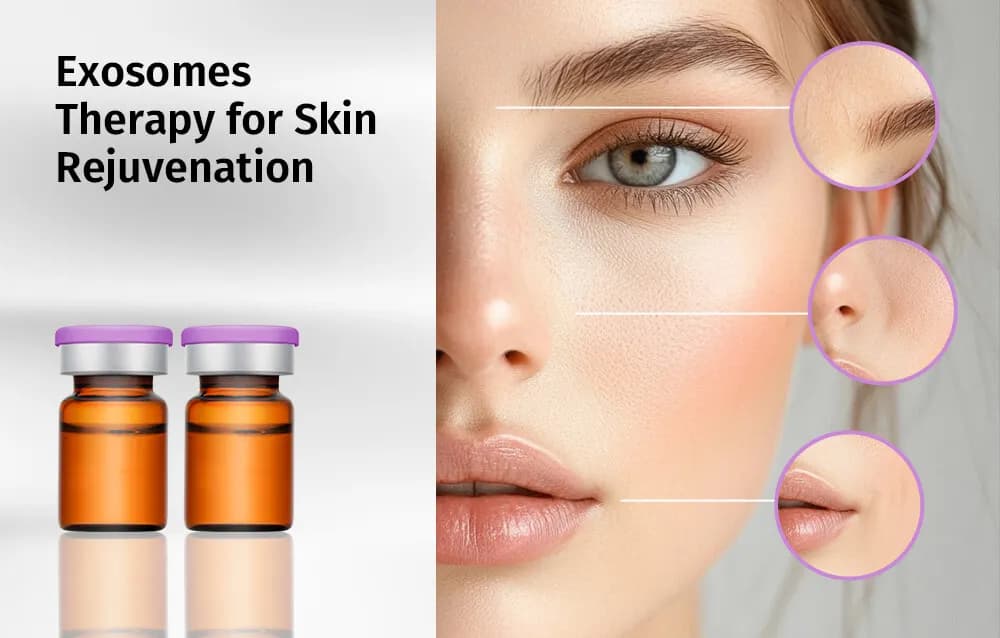
Regenerative medicine has changed the way we care for the skin: instead of just covering signs of aging, it aims to stimulate the body's own repair mechanisms. Two of the most talked-about treatments are exosomes and PRP (platelet-rich plasma). If you're wondering which one is better for your skin, in this guide we compare exosomes vs PRP point by point to help you decide.
What Are Exosomes and PRP#
Although both belong to the regenerative world, their origin is different.
PRP (platelet-rich plasma) is obtained from your own blood. After a simple draw, the sample is centrifuged to concentrate the platelets, which contain growth factors. That concentrated plasma is then applied to the skin to stimulate repair.
Exosomes are tiny vesicles that act as messengers between cells. They carry signals (proteins, growth factors, and genetic material) that help coordinate regeneration processes and cellular communication. If you want to go deeper, check out our guide on exosomes for rejuvenation.
How They Work on the Skin#
- PRP: By releasing growth factors from your own platelets, it stimulates fibroblast activity and supports collagen production. It's an approach that taps into your own body's resources.
- Exosomes: They act as communication signals that can enhance the skin's regenerative response. Their ability to transmit cellular information is what makes them so interesting in advanced aesthetics.
In both cases the goal is similar: to improve the quality, firmness, and radiance of the skin by supporting its natural renewal processes.
Skin Results#
Both treatments aim for firmer, more hydrated, and more radiant skin, but there are nuances.
- PRP: Usually associated with improved texture, radiance, and overall firmness. Coming from your own blood, it is a popular option for those who prefer an autologous approach.
- Exosomes: Linked to a strong regenerative response and improvements in radiance, texture, and the overall appearance of the skin.
It's important to remember that results vary depending on age, skin type, starting condition, and each person's habits. No treatment offers identical results for everyone, which is why a professional evaluation is key.
Number of Sessions#
- PRP: Typically planned in schemes of several sessions (for example, 3 sessions a few weeks apart), with follow-up maintenance depending on the case.
- Exosomes: The number of sessions depends on the protocol and the goal, and is usually defined during the consultation according to your skin's needs.
In both cases, the exact plan must be personalized. What works for one person is not necessarily ideal for another.
Who Each Treatment Is For#
- PRP may suit you if you prefer a treatment that uses your own blood, want to improve texture and radiance, and are interested in an autologous approach.
- Exosomes may suit you if you're looking for a regenerative boost and improvements in the overall appearance of the skin, especially as part of an advanced aesthetics plan.
The choice depends on your goals, your skin type, and the professional recommendation after evaluating you.
Can They Be Combined#
Yes. In many regenerative medicine protocols, treatments complement each other or are combined with other technologies to enhance results. The decision to combine them, as well as the order and timing, should be made by a professional who knows your case. There are also other regenerative options such as PDRN and cellular regeneration that can be part of a comprehensive plan.
Comparison Table: Exosomes vs PRP#
| Criterion | Exosomes | PRP |
|---|---|---|
| Origin | Messenger vesicles | Your own blood |
| Mechanism | Cellular communication signals | Platelet growth factors |
| Approach | Regenerative stimulus | Autologous (from your body) |
| Skin goal | Radiance, texture, firmness | Texture, radiance, firmness |
| Sessions | Per personalized protocol | Several sessions + maintenance |
| Combinable | Yes, within a plan | Yes, within a plan |
Which One to Choose#
There is no absolute winner: exosomes and PRP are two different paths toward a similar goal. The best decision comes from answering a few questions with professional guidance: what your skin needs, what your main goal is, how much time you can dedicate to the process, and whether you prefer an autologous approach or a regenerative stimulus based on cellular signals.
The wisest thing is not to choose blindly. A professional evaluation makes it possible to assess your skin and design the most suitable protocol for you, whether that's exosomes, PRP, or a combination. Learn more about our exosomes treatment and what it can offer your skin.
Conclusion#
Both exosomes and PRP are part of regenerative medicine aimed at supporting the skin's natural processes. PRP stands out for its autologous approach; exosomes for their role as cellular messengers. In many cases they can even complement each other. Remember that results vary from person to person and that any decision should be backed by a serious evaluation.
If you want to know which option is ideal for your skin, we invite you to book an evaluation with our team. We will analyze your case and recommend the most suitable path for your goals.
Keep reading
Related articles
Regenerative Medicine & Rejuvenation
Exosomes: The Treatment Revolutionizing Skin Rejuvenation
Discover how exosomes regenerate your skin at the cellular level. Proven effects, indications, and why they are the top trend in aesthetic medicine 2025.
Read article
Hydration and Skin Boosters
Deep Skin Hydration: Treatments That Actually Work
Discover skin boosters, exosomes, and PDRN: the most advanced deep hydration treatments beyond traditional creams for lasting results.
Read article
Laser Treatments
Laser Hair Removal vs Waxing: Which Is Better
Laser hair removal vs waxing: we compare long-term cost, pain, durability, ingrown hairs, and comfort so you know which one is really worth it.
Read article